When it comes to lifting and rigging, what happens before the lift is just as important as the lift itself.
Every safe, successful lift starts with planning. And yet, many lifting incidents aren’t caused by equipment failure—they’re caused by something being missed.
Whether it’s a load shifting on a forklift-assisted lift or a sling failure during a hoist operation, the root cause is often the same: lack of planning.
For example, studies estimate that up to 90% of crane-related accidents are caused by human error, including poor planning, miscommunication, and incorrect load handling.
That’s why asking the right questions—every time—matters.
Here are seven critical questions every rigger should ask before the lift begins.
1. Do we know the exact weight of the load?
This may seem basic, but it’s one of the most common points of failure.
Underestimating weight can lead to:
- Overloading equipment
- Sling failure
- Dropped loads
According to OSHA, overloading and rigging failure are recognized contributors to lifting accidents.
If you don’t know the weight, don’t guess—verify.
2. Where is the center of gravity?
A load that isn’t properly balanced is unpredictable—and dangerous.
Improperly identified center of gravity can cause:
- Load shifting
- Sling slippage
- Sudden rotation during the lift
Dropped loads are often tied directly to poor rigging practices, including miscalculating load balance.

3. Is the right rigging gear being used?
Not all slings, hooks, or hardware are interchangeable.
Ask:
- Is the Working Load Limit (WLL) sufficient?
- Is the hitch type correct?
- Are all components compatible?
Research shows that rigging failure is a leading factor in dropped loads and fatalities, with improper equipment selection playing a major role.

4. Has all equipment been properly inspected?
Inspection isn’t just a box to check—it’s a critical safety step.
Look for:
- Cuts, frays, or deformations
- Damaged hooks or hardware
- Missing or illegible identification tags
Defective rigging gear can lead to load failure, equipment damage, and serious injury.

5. What does the lift path look like?
A safe lift isn’t just about going up—it’s about where the load travels.
Evaluate:
- Obstacles in the path
- Overhead hazards (like power lines)
- Personnel in the area
Contact with power lines alone accounts for a significant portion of crane-related incidents.
And remember: no one should ever be under a suspended load.
6. Is the team aligned and communicating clearly?
Even a perfectly planned lift can fail without clear communication.
Confirm:
- Who is the signal person?
- Are signals understood by everyone?
- Is there a clear chain of command?
Miscommunication is one of the most common causes of lifting incidents—especially in complex or fast-moving environments.

7. Are conditions safe to proceed?
Conditions change—and they matter.
Consider:
- Weather (wind, heat, visibility)
- Ground stability
- Jobsite congestion
OSHA requires employers to assess site conditions and hazards before lifting operations begin to ensure safe execution.
Why This Matters
Lifting and rigging operations carry inherent risk.
- Over 2.6 million workplace injuries are reported annually in the U.S., many involving contact with equipment or overexertion.
- In lifting operations, dropped loads and struck-by incidents remain among the most serious hazards.
The difference between a routine lift and a serious incident often comes down to preparation.
The Bottom Line
Safe lifts don’t happen by accident—they’re the result of deliberate planning, the right equipment, and a team that knows what to look for.
By asking these seven questions before every lift, you’re not just checking a box—you’re protecting your crew, your equipment, and your operation.
Need Help Planning Your Next Lift?
At CERTEX, we work alongside our customers to make complex lifts safer and simpler—from product selection and inspections to custom-engineered solutions and training.
Because when it comes to lifting, the right preparation makes all the difference.
Next Steps:
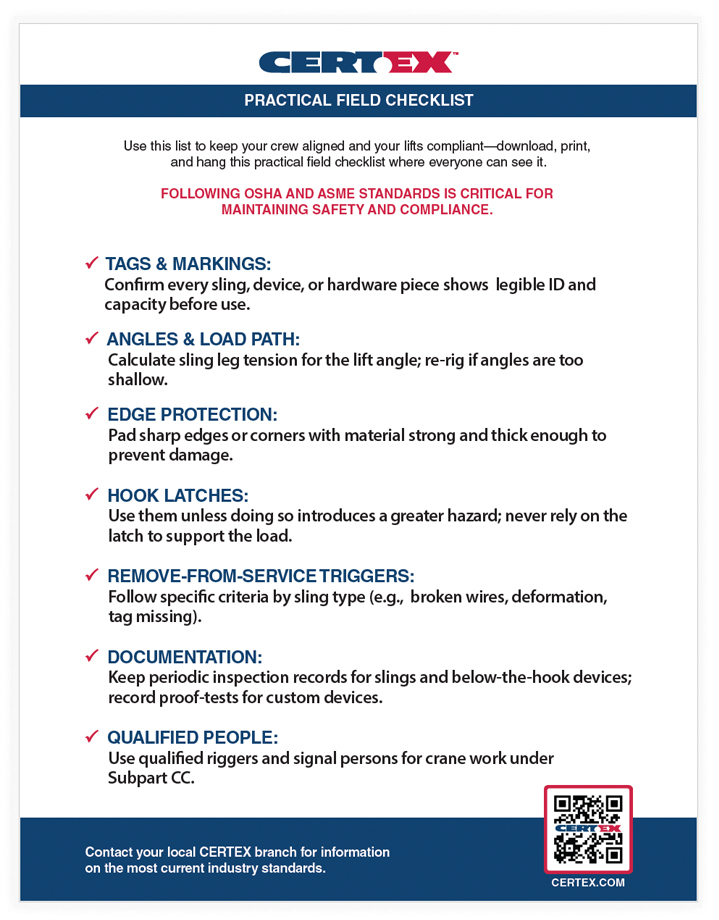
- Download our Practical Field Checklist PDF and our Rigging Inspection Checklist PDF
- Contact CERTEX for a Rigging Safety Audit at your site
- Share this with your crew before your next shift
Find your nearest CERTEX branch and connect with a team that understands your operation.